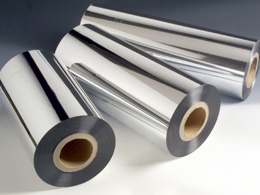
Metallized PET Film: Metal Shedding in Converting
Oct 28,2026 | FOSHAN CAILONG METALLIC PACKAGING MATERIAL CO.,LTD
Metallic-looking particles on a roller or a printed panel can interrupt a converting trial and create uncertainty about the incoming web. Buyers evaluating Metallized PET Film should establish what transferred, where it originated and at which operation it appeared. A published metal-adhesion result is useful material information, but it is not a guarantee that every contact and cutting process will produce no debris.
The high-adhesion PET product in Cailong's film portfolio is designed around improved attachment of the aluminum layer to its substrate. Cailong describes it for laminate applications. That positioning makes it a candidate where coating attachment matters. It does not establish a universal particle-release limit for the customer's rollers, slitter, printing system or completed laminate.
Identify the material before naming the failure
Collect representative debris using an agreed procedure and retain the relevant film samples. A bright particle may come from the coated web, another material or equipment contact. Appearance alone cannot establish its composition. Use appropriate examination where needed, and preserve the collection location so the result can be connected to a particular stage rather than to a general housekeeping observation.
Record whether particles occur on one roller, along a film edge or across the web. Note whether they appear before or after cutting and whether the pattern follows the printed layout. These observations can narrow the investigation. Do not combine debris from several stations into one sample and then assume its result describes the condition at every location.
Follow the web through contact points
Map which face contacts each relevant roller or guide. An exposed metallized face can encounter a different contact from a PET face or a coating buried within a laminate. Preserve that orientation in the trial record. Without it, a supplier may be asked to explain damage to a surface that did not pass through the suspected contact point.
Compare samples immediately before and after the operation where transfer first becomes visible. Inspect the web and the contact surface together. Keep process conditions identified, including any change that coincided with the event. This sequence helps locate the onset instead of treating material found at the end of a line as proof that it was present on the incoming roll.
Distinguish edge debris from face damage
Slitting introduces new edges and can create a different investigation from broad rubbing against the coated face. Observe whether debris is concentrated near cuts and whether the converted edge shows a corresponding change. The condition of tooling and the actual slit process need review alongside the supplied material. A wide uncut sample may not reproduce the event.
For face-related transfer, examine the contact geometry and the resulting pattern. A repeated line or localized scuff suggests a different route from uniform transfer across the entire surface. Keep this diagnosis evidence-based. Do not declare a process defect or coating defect solely from the pattern without the supporting specimens and comparison needed to confirm the cause.
Keep adhesion measurements within their scope
Cailong's public table identifies an EAA-based aluminum-adhesion entry for the selected product family. Ask what specimen preparation and interface that result represents before using it in a purchasing comparison. A measured separating force answers the stated test question. It does not directly quantify loose particles produced during a customer's particular rubbing, winding or cutting operation.
Likewise, a laminate peel test may separate at an adhesive interface while leaving the metal attached, or it may reveal another failure location. Record the actual separated surfaces. Treating every peel number as a metal-shedding measure can hide the relevant distinction and lead to an ineffective material change. The investigation should name both the method and the failure it observes.
Create a representative transfer trial
If a controlled contact test is needed, define the contacting material, motion, loading and specimen orientation with the technical teams. Use conditions relevant to the actual converting event. The product page does not prescribe a universal rub count or acceptance value. Any proposed limit needs an agreed basis and should identify what transferred material is being assessed.
Keep unexposed references and repeat the comparison on identified samples. If a cleaning or contact-surface change is proposed, record it as a process change. If a different metallized film is proposed, hold the other important conditions constant. Changing several variables together may stop the transfer without establishing which one needs to be controlled in production.
Inspect consequences beyond the visible particles
Transferred debris can matter because of its location and the final application, not simply its total amount. Define the actual concern: visual contamination, printing interference, package cleanliness or another specified requirement. Use the relevant inspection and acceptance criteria. Avoid promising that a material is particle-free from a general high-adhesion description.
Also examine whether the affected web has retained the required functionality. Where the packaging brief includes barrier, obtain suitable evidence after the relevant converting sequence. A clean-looking roller does not prove retained transmission performance, and particles on a roller do not alone establish a barrier loss. The package result needs its own interpretation.
Send the supplier a traceable investigation
Provide Cailong with lot identity, converted structure, web orientation and the first station where transfer is observed. Include incoming and affected specimens and describe how the debris was collected. State the application requirement and the conditions that reproduce the event. This gives the supplier more useful evidence than an unqualified request for stronger aluminum adhesion.
The appropriate material or process change follows the identified transfer route. High-adhesion metallized PET can be compared for the coating-attachment role it is designed to perform, while particle release is evaluated under the actual conversion conditions. Keeping those questions separate helps the converter control the source of contamination without assigning unsupported guarantees to a laboratory adhesion value.
Comment