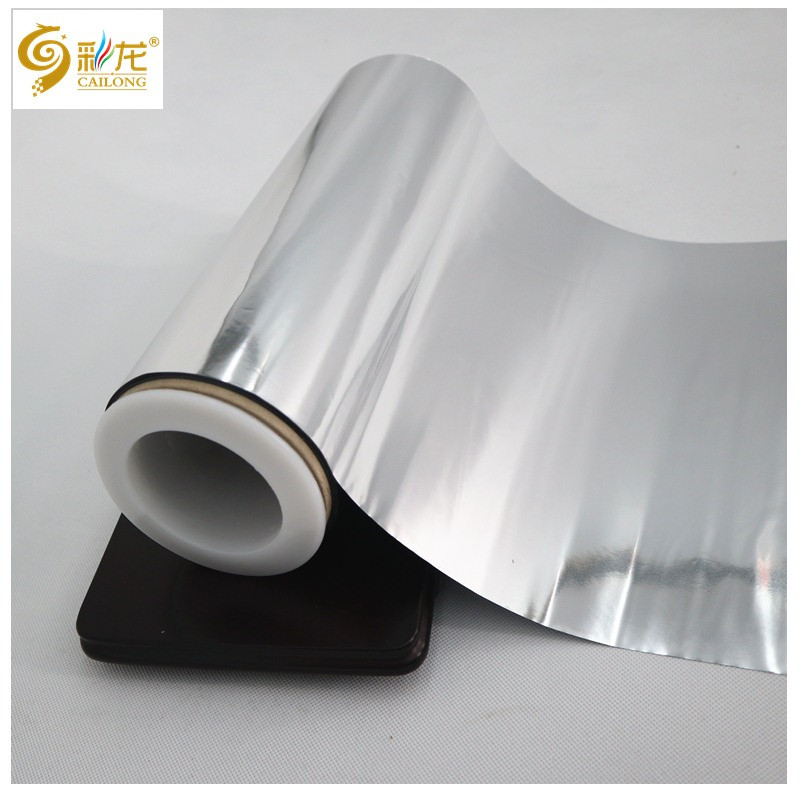
UV Printed VMPET for Retail Header Cards
Nov 20,2026 | FOSHAN CAILONG METALLIC PACKAGING MATERIAL CO.,LTD
A metallic header card can draw attention to a hanging accessory while leaving room for a model name, quantity and compatibility information. Buyers evaluating UV printed metallized PET can combine an exposed metallic band with printed areas whose contrast remains stable on the retail hook. The material choice starts with the display and the conversion route. The thickness of the support, shape of the fold and location of the hang hole all affect the finished appearance and handling.
Cailong's film portfolio lists UV printed metallized PET film for decorative printing applications. Confirm whether the quote covers a finished printed roll or the film construction intended for the buyer's print process. Establish the visible side, film thickness and available width. The metal appearance and print work together on the card, while the card stock and attachment carry the weight of the product.
Decide where metallic decoration helps the display
Hang the actual product in a simple display mockup. Mark the area occupied by the hook, the header and the item below it. A narrow band across the top can keep the model name prominent. A full metallic face can change how the printed hierarchy reads under a row of overhead lamps. Compare the two arrangements on cards made at full height so the reflection can be judged at a normal viewing angle.
Keep the product identifiers in the affected area of the print trial. A bright reflected field may stand out but make a small accessory code harder to read. Use a printed block where the layout needs predictable contrast. If the pack includes several versions of the same item, hang neighboring cards alongside it so a buyer can see whether the designs are distinct from one another.
Choose a support and print construction
Draw the metallic facing, print layers and board or other support. Specify which side carries the visible print and how the film will be joined to the card. If the header folds over the top of a bag, locate the fold and show whether the printed surface continues across it. For a single flat card, give the converter the visible edge finish and position of any attachment. The material can often be quoted in rolls or converted parts, with cost and responsibility depending on what is supplied.
Ask the converter which ink and supporting layers are used for the representative proof. A color viewed directly over metal can look different from the same color printed over an opaque area. Approve a layout that includes both effects if both will be sold. Keep any layers that affect the appearance tied to the final artwork so a production sample is compared under equivalent conditions.
Review the fold and hanger with the product fitted
Produce samples with the intended board, film and cutting geometry. Put the hang hole and any folding line in their production locations. Inspect the graphics near those features after cutting and folding. Where an edge or line remains visible, note whether it is part of the expected finish. If it affects an important graphic, compare the design with an approved alternative that moves the graphic clear of the feature.
Hang the card with the actual accessory and inspect how it sits. A product with uneven weight may twist the front face away from the position used to approve the proof. Record the natural resting angle and check if the artwork remains clear there. If the product will hang beside others, include the spacing and typical contact with adjacent cards. The approved material should be seen in its finished display position.
Qualify handling in the expected delivery format
Run the buyer's normal pack-out and unpacking routine across a representative group of completed cards. Note whether metallic faces touch other faces or a carton divider. Inspect for the type of mark that would matter on the store display. Record whether it appears in an exposed band or on the printed surface. Store an unused proof and an assembled sample with the same identification.
Include how staff install the cards on the rack and how customers handle them. A header made to hold an accessory while hanging can also need clear text when it is picked up and turned. Keep the actual item, backs and retail tags in the viewing reference. If model information is on the reverse, check it with the production print and cut positions.
Give the converter an application reference for the next order
Specify the film width, gauge, visible metallic appearance and print requirement. Provide the card drawing, fold and hanger location, product weight range and artwork. Explain whether supply should be unprinted film, printed roll stock or completed cards. Retain a mounted reference and one flat proof so the supplier can compare the film and the converter can compare the complete card.
For an assortment with several accessory shapes, place the deepest and the lightest packs on the same display fixture. The deeper pack can push a neighboring card out of plane, while the light pack can move when the customer withdraws another one. Check how both conditions affect the alignment of the metallic graphic and hook. This is also a good point to verify that barcodes and item identifiers stay accessible without removing the card. Share a photograph with the converting drawing.
For a family of accessories using the same header construction, attach the artwork versions to the common material and board specification. Fit the largest and most unevenly loaded accessory before extending approval to the entire range. If a new item changes the resting angle or adds another contact point, review the affected area with the same finish reference. Purchasing can then reuse the selected film in the agreed formats and request the exact variation needed for a new card.
Comment