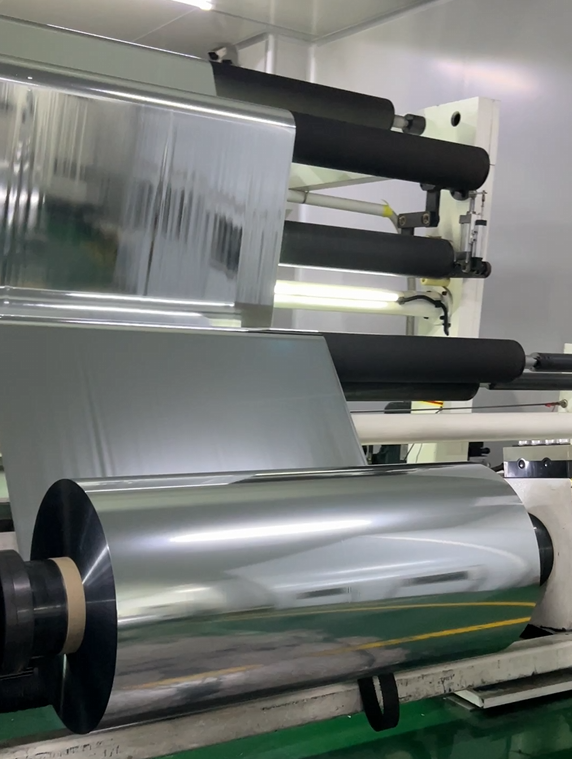
Metallized MDOPE Film for Bag Stack Slip
Nov 13,2026 | FOSHAN CAILONG METALLIC PACKAGING MATERIAL CO.,LTD
A flexible bag that travels smoothly through filling can begin to slide when several finished bags are stacked and moved into a case. The change may first be noticed as a leaning stack, a pouch left behind on a transfer plate or an operator slowing the equipment to keep the edges aligned. Buyers trialing metallized MDOPE film should keep the desired barrier construction in the comparison while investigating the surfaces that actually touch during stacking. The finished outside face can differ substantially from the metallized web inside the laminate.
Cailong's film portfolio lists metallized MDOPE for lamination and packaging. The product listing provides a thickness range and customized roll dimensions. Use the specific supplied gauge and width when planning a trial. The listing describes the base material, and the packing equipment will encounter the outer print, coating or laminate face selected by the converter. Ask which surface will be exposed before using a raw-film friction value as a purchasing specification for a finished bag.
Identify the surfaces that move
Draw the bag in the orientation used at each transfer. Mark the face against the conveyor, the face against the bag below, and any printed or sealed region that repeatedly contacts another bag. Some stacks alternate bag direction to balance the seal thickness. That pattern can create a face-to-face contact in one position and a face-to-back contact in another. Recreate the actual pattern before asking a laboratory to measure friction between two pieces.
If the bags slide while held by a plate or guide, retain a representative contact sample or have the line team identify its material and finish. Bag-to-bag and bag-to-equipment contacts can produce different behavior. Record the point at which a stack first becomes unstable. A change after the push into the carton can involve the opening or liner of the carton even when the stack is steady on the infeed.
Compare the finished surfaces after conversion
Collect control and candidate bags from the same stage in the process. Include the production outer print or coating and note the time since converting. Compare the surfaces after the handling interval expected at the filling plant. Stock that is tested shortly after conversion may differ from stock opened after storage and transport. Preserve labels from the parent and slit rolls so the converter can identify the actual web used in the bag.
Where coefficient of friction measurements are available, identify the contact pair, sliding direction and conditioning used by the laboratory. Compare initial movement and continuing movement as separate observations. Keep the laboratory result tied to the finished surface tested. If the print pattern changes across the pouch, consider testing pieces from a representative printed area and a different area that also carries load in the stack. A measurement from an unprinted margin may answer only a narrow part of the packing question.
Recreate the bag profile under load
Use the intended contents or an approved trial fill with representative shape and mass. Record fill level, pack dimensions and headspace handling. A puffy bag may touch the next bag on only a small area, while a flatter construction distributes the load across a broader face. Keep the fill and sealing arrangement fixed when first comparing materials. Include the accepted carton size and stack count so a difference caused by pack profile can be recognized.
Run the candidate and incumbent through the same transfer sequence at agreed trial settings. Observe the stack immediately before the first push and again at the receiving point. Where the line team can safely do so, use fixed camera views or physical references to record lateral movement. Keep results from deliberate process changes separate so the team can see whether the original setup and the revised setup are equivalent.
Determine whether the issue follows the film or the pack
If both materials slip only when the upper bags land off center, review the stacking action before changing the material requirement. If one candidate moves consistently while the incumbent stays in position under the same conditions, compare the finish and friction records for the contacting faces. Inspect for damage, transferred ink or coating marks after the trial. A pack that stays aligned through one transfer can still show marks or blocking after it waits under load.
If the first fix changes the outer coating or varnish, retain both versions of the same barrier laminate for comparison. Check print appearance, adhesive compatibility where relevant, seal integrity and barrier on the final construction using the buyer's existing acceptance plan. Changing the outer surface can address stack movement while introducing a separate converting or appearance issue. Record the effects together before freezing the purchasing specification.
Give the supplier a clear trial target
Send the roll dimensions, layer sequence, external contact surfaces and typical production orientation. Describe when the stack moves and provide a representative finished bag or a short recording if available. Specify whether the supplier is quoting a barrier film for conversion or a finished laminate. Those two supply scopes give the supplier different control over the outside face and its performance on the line.
Retain a section of the approved outer web and several finished bags as reference samples. Include how the packages were conditioned, stacked and handled. If a second case configuration changes the bag orientation, qualify it using its actual contacts. Once the converter and the packing team agree on the surface and handling criteria, reference them alongside the required barrier and roll construction on the next purchase order.
For a multi-lane line, record which lane produced each bag in the trial. A difference in how the bags leave one lane can change the shape of the stack before friction becomes visible as a problem. Review repeatable movement by lane before setting a common material limit.
Comment