Copper Metallized PET Film for EMI Shielding
Aug 19,2026 | FOSHAN CAILONG METALLIC PACKAGING MATERIAL CO.,LTD
Flexible electronic assemblies often need a conductive layer without the weight, thickness, or forming limits of solid metal foil. Copper metallized PET film for EMI shielding is one option because it combines a polymer carrier with a thin conductive copper surface. It can be supplied in rolls, slit, laminated, die-cut, or converted into tapes and shielding components.
The sourcing risk is that “conductive film” is not a complete specification. A low sheet-resistance value may look attractive on a data sheet, but shielding performance can still change with copper-layer uniformity, adhesion, bending, contact design, grounding, adhesive selection, surface oxidation, and the geometry of the finished component.
For procurement and engineering teams, qualification should therefore connect the electrical requirement with the converting process and final assembly.
What Copper Metallized PET Film Actually Combines
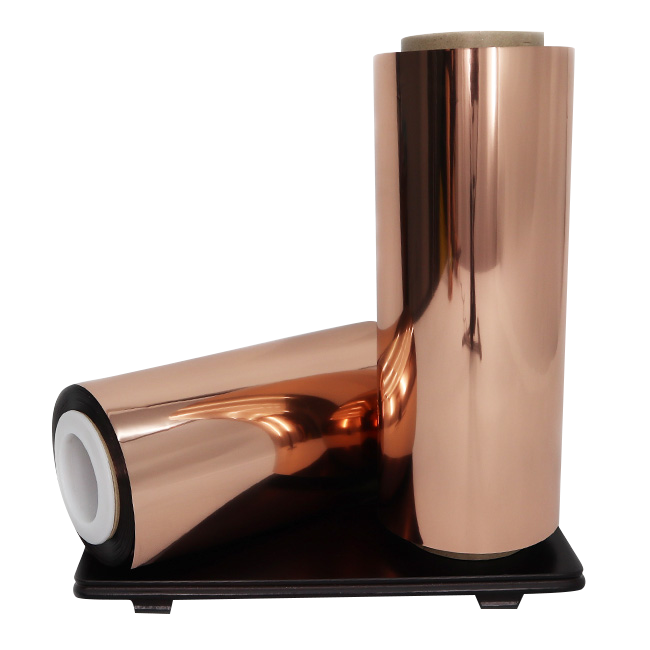
Cailong’s Copper Metallized PET Film uses physical vapor deposition to place a high-purity copper layer on a flexible film substrate. The current product information describes copper purity above 99.99% and lists applications including electromagnetic shielding, electronic circuits, heat dissipation, conductive tape, electronic tape, anti-counterfeit labels, and decorative uses.
Compared with a solid copper foil, the polymer substrate can reduce overall metal usage and provide a flexible roll-format material that is easier to integrate into some thin or shaped components. The tradeoff is that the conductive layer is much thinner than a foil, so surface continuity and processing damage matter more.
The film should be treated as a functional layered material. PET contributes dimensional stability and handling. The copper surface provides electrical and thermal conductivity. Adhesive, coating, contact points, and assembly design determine how much of that performance survives in the final part.
Why Sheet Resistance Is Only the First Electrical Check
Sheet resistance, expressed in ohms per square (Ω/□), is a common way to compare conductive films. It describes resistance across a uniform thin conductive layer independent of the size of the square being measured.
For Cailong copper metallized film, selected grades can reach sheet resistance as low as about 0.3 Ω/□ under specified test conditions. That is useful for screening a conductive material, but it should not be converted directly into a universal EMI shielding result.
Shielding effectiveness depends on frequency, layer continuity, grounding, overlap, seams, apertures, contact resistance, component shape, and the complete shielding system. A film with a good sheet-resistance value can still perform poorly if the copper layer is damaged during slitting or if the grounding path is inconsistent.
A purchasing specification should therefore define both the incoming material requirement and the finished-part requirement.
Copper Metallized PET Film for EMI Shielding: Define the Frequency and Geometry
EMI problems are application-specific. A shield used around a cable, battery module, display, sensor, flexible circuit, or electronic housing may face very different frequencies and mechanical conditions.
Before choosing the film, document:
frequency range of concern;
target shielding effectiveness for the finished assembly;
available space and allowable material thickness;
whether the shield will be flat, folded, wrapped, or die-cut;
grounding or bonding method;
expected bending cycles;
operating temperature and humidity;
chemical or adhesive exposure;
edge and seam design;
required service life.
Without these inputs, comparing conductive films only by sheet resistance can lead to over-specification or hidden failure.
Compare Copper Metallized Film with Solid Copper Foil
Copper foil remains a strong option when high conductivity, solderability, current carrying, or robust metal thickness is required. Copper metallized PET film serves a different design space.
Solid copper foil
Typical strengths include high bulk conductivity, a thicker metal cross-section, and established use in electrical and thermal applications. It can also tolerate some types of surface damage better because the conductive layer is not only a thin deposit.
Potential limitations include higher metal usage, greater weight, more stiffness at comparable constructions, and different forming or handling behavior.
Copper metallized PET film
A metallized PET structure can provide a lightweight, flexible conductive surface on a dimensionally stable polymer web. It is useful where conductivity, shielding, reflectivity, decorative appearance, or heat-spreading functions must be integrated into a thin roll-convertible material.
The selection should not be framed as “film is better than foil.” The correct choice depends on required conductivity, mechanical flexibility, thickness, current load, contact method, process route, and total component cost.
Electrical Uniformity Across Width and Length Matters
A single laboratory measurement cannot represent an entire production roll.
For EMI shielding and conductive tape applications, buyers should ask how sheet resistance is controlled across the web and along the roll. The acceptance plan can include measurements at the left, center, and right side of the web and at several positions along the roll length.
Record the test method, probe configuration, conditioning, and surface state. Contact pressure can influence measured resistance on thin conductive surfaces, so test consistency matters.
For tight electrical applications, consider specifying:
target sheet-resistance range rather than only a maximum;
cross-web variation;
roll-to-roll variation;
sampling frequency;
traceability to production batch;
handling rules before measurement.
This turns a marketing value into a controlled incoming-quality parameter.
Copper-Layer Adhesion Protects Downstream Performance
Conductivity is only useful if the conductive layer stays attached through converting.
The copper surface may experience tension, roller contact, slitting, die cutting, adhesive coating, lamination, bending, or repeated flexing. Poor metal-to-film adhesion can create flaking, transfer, local resistance increases, or visual defects.
Where adhesion is critical, buyers should define an agreed test method and minimum result for the exact grade. Cailong has previously provided copper-film adhesion information around 3 N-class performance for selected products, but the order specification should use the supplier’s current grade-specific data rather than treating one historical value as universal.
During trials, inspect both the PET surface and the separated material after peel or tape tests. If copper transfers to the adhesive or tool surface, the failure location should be documented.
Slitting and Die Cutting Can Create Hidden Electrical Damage
Narrow conductive tapes and die-cut shielding parts are particularly sensitive to edge quality.
A damaged edge can reduce the effective conductive path, create loose metal particles, or expose PET where a grounding contact was expected. Slitting tension and knife condition should therefore be part of the qualification, not only the width tolerance.
For die-cut parts, inspect:
cut-edge cleanliness;
copper continuity near the edge;
burrs or loose particles;
cracks after tight-radius bending;
registration of conductive and nonconductive zones;
resistance before and after forming.
If the part will be folded, use the actual fold radius and number of cycles. Flat-sheet resistance before conversion does not prove conductivity after repeated mechanical stress.
Adhesive Selection Changes the Shielding System
Many EMI shielding parts are laminated to pressure-sensitive adhesive, insulation film, foam, fabric, or another substrate.
The adhesive can affect both mechanical reliability and electrical connection. A conventional insulating adhesive can separate the copper surface from a ground plane, while a conductive adhesive may be necessary when current must pass through the bond line.
The design should state whether conductivity is required:
only along the copper surface;
through the thickness of the adhesive;
across an overlap seam;
from the shield to a chassis or ground point.
This distinction prevents a common sourcing error: buying a conductive film and expecting the complete tape or laminate to remain electrically continuous without specifying the adhesive system.
Oxidation and Surface Protection Should Be Discussed Early
Copper naturally changes at the surface during storage and environmental exposure. In some applications, appearance is not important but contact resistance is. In decorative uses, color stability may be a primary requirement.
Buyers should ask whether the offered grade has a protective treatment, whether that treatment changes contact resistance, and how the rolls should be packed and stored.
Qualification may include heat-and-humidity aging, salt or chemical exposure where relevant, and resistance measurements before and after aging. The exact test should match the final environment rather than relying on a generic accelerated-aging program.
Typical Application Routes
EMI shielding tapes and die-cut components
Copper metallized PET can be laminated to an adhesive system and converted into narrow tapes, gaskets, wraps, or die-cut shielding parts. The design must preserve copper continuity and provide a reliable grounding path.
Flexible electronic circuits and conductive paths
For low-current or functional conductive layers, the film can be evaluated as a lightweight substrate. Circuit geometry, connection method, bending radius, and resistance stability require qualification.
Electronic heat-spreading layers
The copper surface can contribute to lateral heat spreading in thin assemblies. Thermal interface resistance and the complete stack should be tested.
Anti-counterfeit and decorative components
The copper appearance can also be used where conductivity and visual effect are combined. Surface protection and color stability may become more important than minimum resistance.
Supplier Evaluation Checklist for Copper Metallized Film
A copper metallized film supplier should be able to discuss the film as a controlled functional material, not only provide a roll and a nominal resistance value.
Before a commercial order, ask for:
base-film material and available thicknesses;
copper purity and deposition method;
grade-specific sheet-resistance target and tolerance;
cross-web and roll-length uniformity controls;
copper-layer adhesion method and typical result;
available width, slitting capability, and edge-quality standard;
surface protection or treatment, if any;
storage life and packaging method;
traceability and batch documentation;
sample-roll availability for converting and shielding trials.
For demanding EMI projects, the buyer should also share the required frequency range, grounding design, adhesive system, bending conditions, and final component geometry. That information lets the supplier recommend a more relevant grade and trial plan.
A Better Qualification Sequence
A staged trial reduces the risk of approving a film from one attractive laboratory value. First check incoming dimensions, appearance, sheet resistance, and adhesion. Then run the real slitting, lamination, die-cutting, or forming process. After bending, aging, heat, or humidity exposure, repeat electrical measurements and inspect for local discontinuities. Finally, test shielding effectiveness in the representative assembly across the required frequency range and compare more than one production roll before locking the specification.
FAQ
Is lower sheet resistance always better for EMI shielding?
Not necessarily. Lower resistance can help, but shielding performance also depends on frequency, grounding, seams, apertures, layer continuity, and the finished enclosure or component design.
Can copper metallized PET replace copper foil?
It can replace foil in some lightweight conductive, shielding, decorative, or heat-spreading applications, but it is not a direct substitute for every current-carrying or high-conductivity foil function.
What sheet resistance should buyers specify?
Use the requirement derived from the final component. Selected Cailong grades can reach approximately 0.3 Ω/□ under specified conditions, but the target tolerance and uniformity should be agreed for the exact application.
Does cutting affect conductivity?
It can. Slitting, die cutting, tight folds, or abrasion can damage a thin deposited metal layer. Electrical performance should be rechecked after conversion.
What is the most important supplier question besides price?
Ask how electrical uniformity and metal-layer adhesion are controlled across production rolls. Consistency determines whether a lab-approved sample can be reproduced at scale.
Source a Conductive Film as Part of the Electrical Design
Copper metallized PET film for EMI shielding can provide a flexible, lightweight conductive surface for tapes, electronic components, shielding parts, and other converted applications. The best results come when procurement and engineering define the electrical target, mechanical process, adhesive system, grounding method, and acceptance test before the order is placed.
Cailong’s Copper Metallized PET Film is a practical option to evaluate when a project needs a roll-processable copper surface on a stable flexible substrate. Qualification should focus on sheet-resistance consistency, adhesion, conversion damage, aging, and finished-component shielding performance rather than on a single headline value.
Comment